Bink animations & video
Learn how to use the Bink video format to add animations to Hades II.
Make sure you have followed the prerequisites page to install the necessary tools before proceeding.
The initial sections of this guide were adapted from EtchJetty/Girl Bowser's BinkFixTutorial for Hades, which focused on replacing existing bink animations. Anything from the Creating the .bik_atlas section onwards is new and required specifically if you are adding a new bink animation, both to Hades and Hades II.
Bink video files were the basis of all character and enemy animations in Hades, and were also used for full-screen videos (such as the into/outro videos or the main menu background). In Hades II's engine, bink files are supported in the same way, for both animations and videos, though they are only used for videos anymore.
Before we start
Before we continue, please take note of a couple of important pieces of information regarding this guide:
- As we are limited to using bink files, there currently is no way to add new animations to existing characters or enemies in Hades II, as these use 3D models and animations. You can only add new characters or full-screen videos (unless you figure out a way to blend between the 3D and 2D animation systems).
- To add a new animation or video, there needs to be any existing bink animation/video with the same resolution already in Hades (if you own the game) or Hades II. Adding animations with different resolutions might be possible with a lot of work, but has not been done yet and won't be covered in the guide.
- The guide will not include any information on how to create models or animations to be converted into the bink format, only how to transform a
.pngsequence into a.bikfile, and how to use this in the game. The BinkFixTutorial contains a section on creating a source animation. - The guide will not go in-depth on the
.bikfile format itself, and only cover the basic usage through RAD Video Tools. - In general, the guide will be very light-weight, and heavily reference EtchJetty/Girl Bowser's BinkFixTutorial for Hades, as there is likely going to be very low demand for adding new bink animations to Hades II. Please reach out in the Hades II Modding Discord if you have any questions or suggestions!
For this guide, we'll use the example of a new full-screen video, which can be used as a dialogue background animation in Hades II.
Character animations work the same way, but will require additional work on the sjson side of things, which is not covered in this guide - the best reference material for this is the Hades (first game) code itself, which used bink animations for all characters and enemies.
Setting up your .png sequence
If you're already familiar with the BinkFixTutorial, you can directly skip to the Creating the .bik_atlas section, as this was not covered in that guide and is required to use new bink files in the game.
The basis of any bink animation is a sequence of .png images, each representing one frame of the animation.
These can be with or without transparency, depending on your needs.
You can only add bink animations or videos with resolutions of an existing bink file used in either Hades or Hades II. For full-screen videos this is easy (1920x1080 or 1280x720), but for character animations you will need to find an existing animation with the same resolution as your desired one.
For our use case, we have created the following sequence of images:
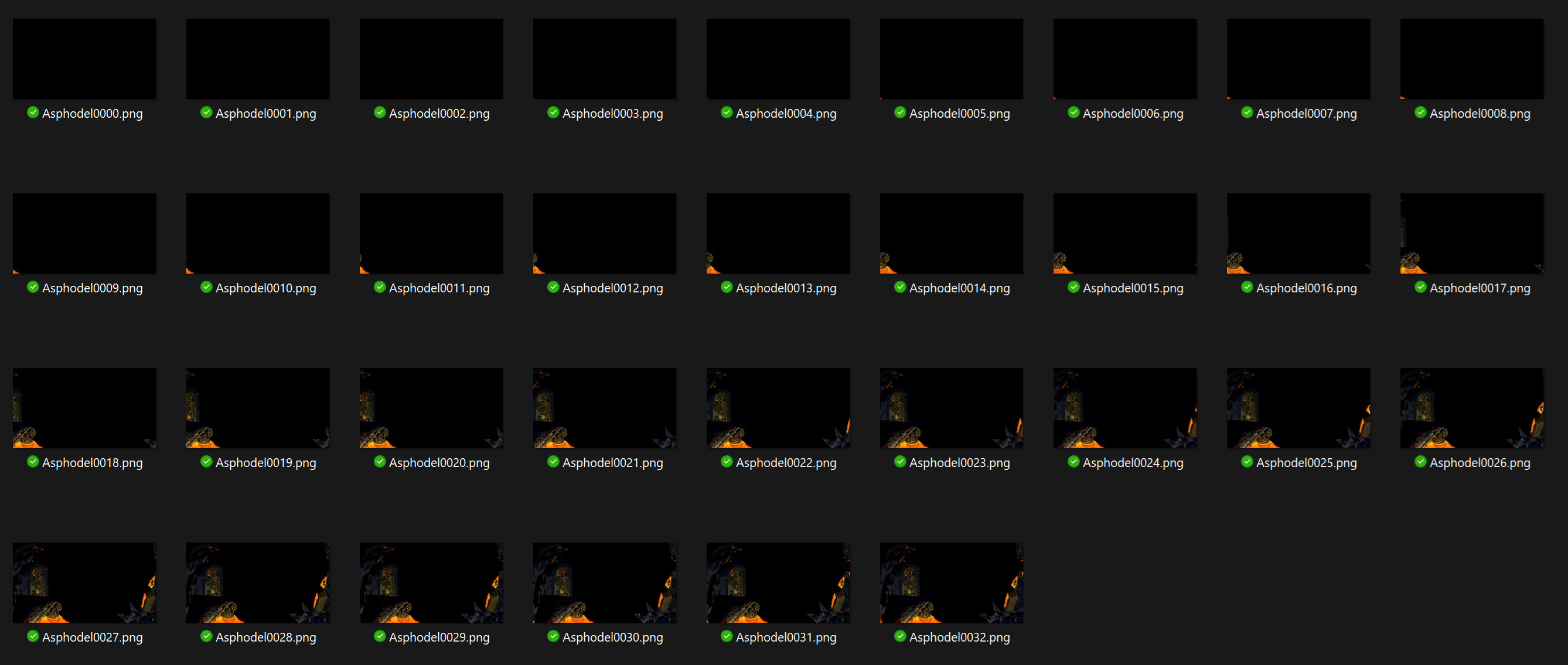
It's a good idea to name the files with a common suffix containing the frame number, which will make generating the .bik file easier later on.
Remember that you have a lot of tools available to modify the resulting bink file though sjson in the game, such as reverse playback, playback speed, setting custom start and end frames, etc. This way, you don't need to create multiple animation files for these effects.
Generating the .bik file
With your .png sequence ready, you can now generate the .bik file using the RAD Video Tools.
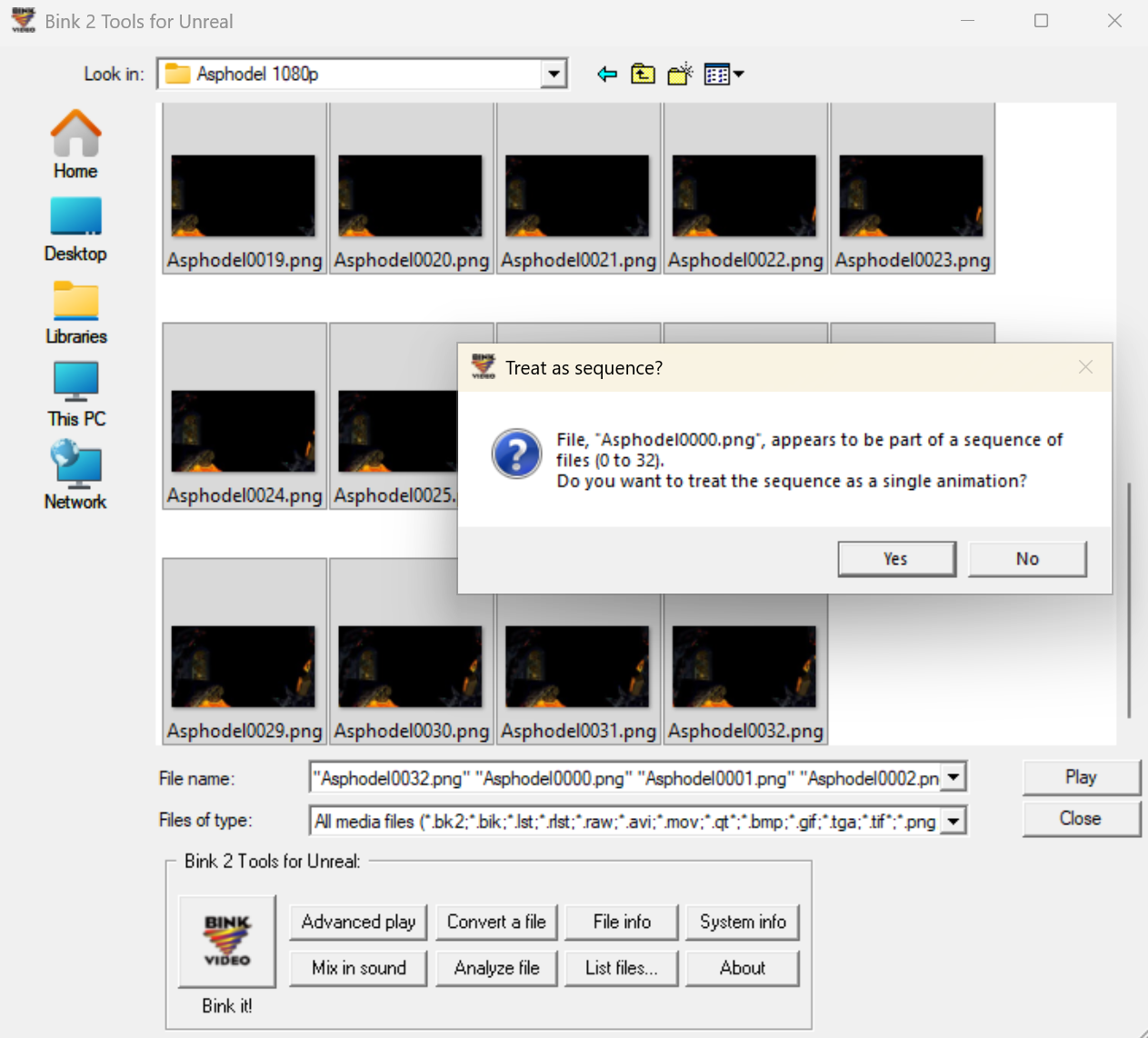
- Open
RAD Video Toolsand navigate to the folder containing your.pngsequence. - Select all image in the sequence at once.
- Click
List files...in the toolbar at the bottom. - Select
Yeswhen prompted if you would like to treat the sequence as a single animation.
- In the new window, you may see items in the list that do not match the pattern (
Asphodein the example) - they might not matter, but it's best toRemovethese. Afterwards, clickClose.
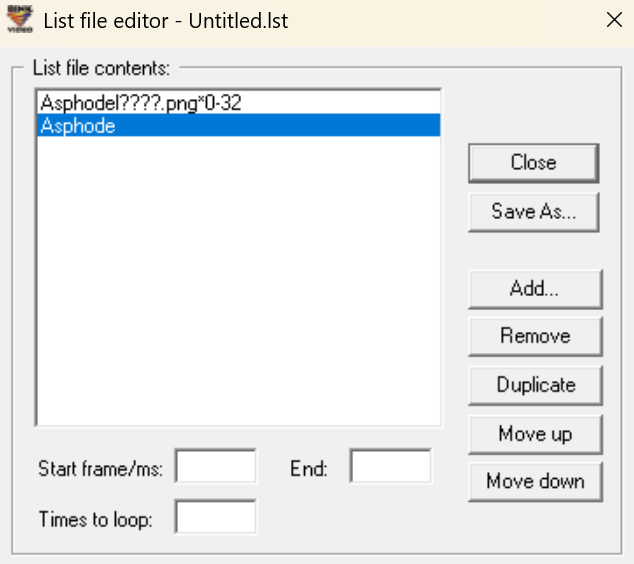
- Select
Yeswhen prompted if you would like to save the changed list file. - Save the
.lstfile in the same folder as your.pngsequence, the name does not matter. - In the main
RAD Video Toolswindow, select the newly created.lstfile and clickBink it!in the toolbar at the bottom. - You'll be presented with a bunch of options. Most of these are irrelevant, but make sure to change/set the following:
- Change the file ending at the top from
.bk2to.bik- Hades II uses the Bink 1 format, not Bink 2. - Make sure that the
File formatis set toBink 2, notBink 2 HDR. - Make sure that the
Overall data rate settingis set toCompress to a % of the original:, with a value of100%. - If your movie has transparency, ensure that the alpha plane setting at the bottom of the
Compression settingssection is set toUse alpha plane unchanged from input file. - You can uncheck
Compress audio, as Hades II does not use this.
- Change the file ending at the top from
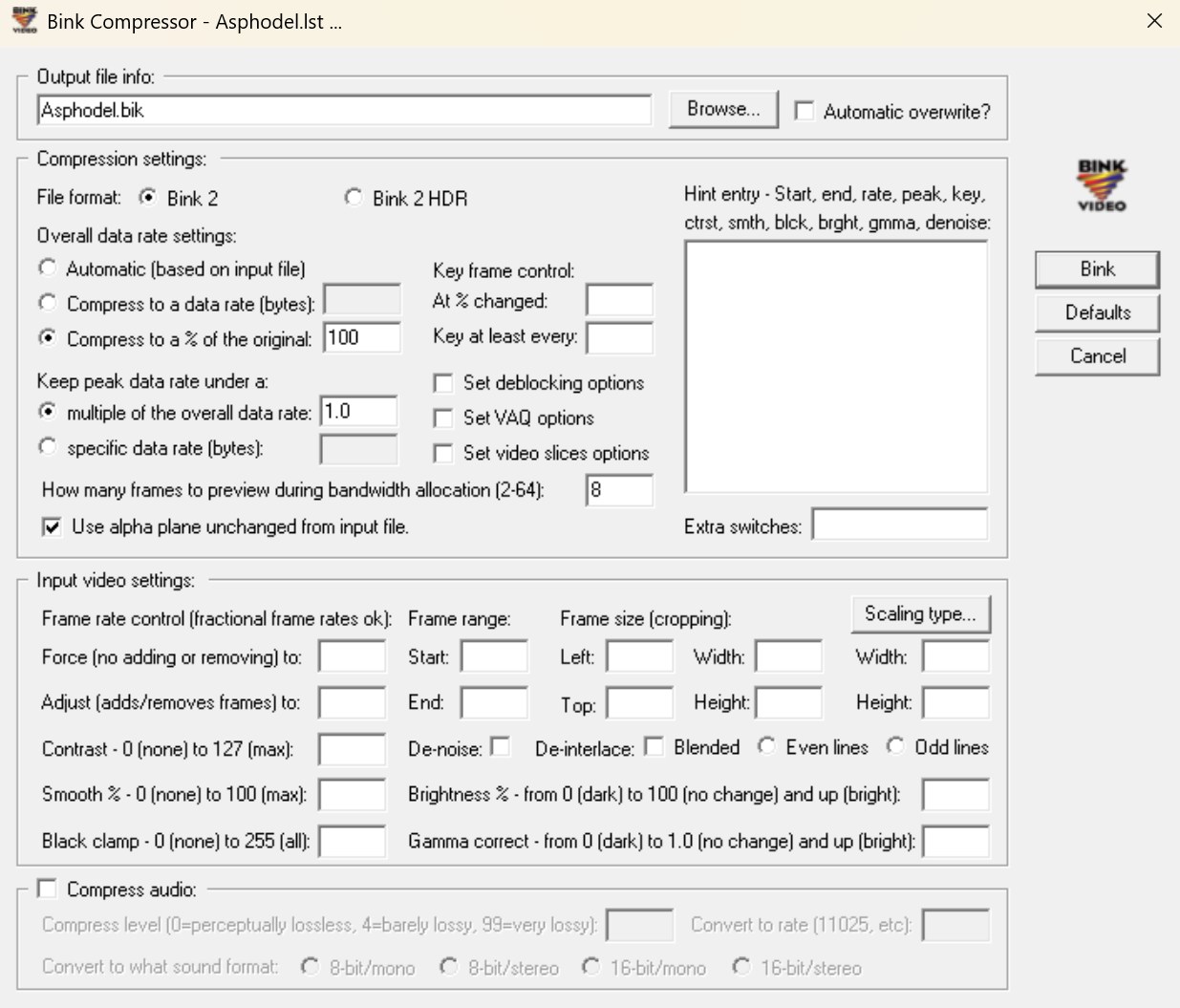
- Your settings should look similar to the screenshot above. Then, click
Binkto generate the.bikfile. - You should now have the
.bikfile in the same folder as your.pngsequence. Selecting it and clickingPlayinRAD Video Toolsshould open the animation and play it.
Creating the .bik_atlas
Before you can use your new bink file in the game, you need to create a fitting .bik_atlas file for it, which contains important metadata, such as the resolution, about the .bik file. We can use the HadesBikAtlas tool for this.
Run this command to create a .bik_atlas. We've renamed the bink file to something more identifying before we actually use it in our mod.
hadesbikatlas create -f "path/to/bink/HadesBiomesDiaBackAsphodel.bik"
You should now have a .bik and .bik_atlas file with the same names in your folder:

Using the new animation in Hades II
After creating the new .bik and .bik_atlas files, you'll need to add them to the plugins_data directory. Within the plugins_data folder you can place them under something like a Movies/<resolution> subfolder. The <resolution> being either 1080p or 720p, depending on the resolution of the asset.
Now, all you need to do is to create the necessary sjson entries to define the new animations using the new bink file.
In our example, these look like this, to create In and Out dialogue background animations:
{
  Name = "ModsNikkelMHadesBiomes_DialogueBackground_Asphodel_In"
  Scale = 1
  FilePath = "NikkelM-HadesBiomesGUIModded\GUIModded\Screens\DialogueBackgrounds\DialogueBackgroundAsphodel"
  VideoTexture = "HadesBiomesDiaBackAsphodel"
  NumFrames = 32
  StartFrame = 1
  EndFrame = 32
  HoldLastFrame = false
  FlipHorizontal = true
  Loop = false
  PlaySpeed = 50
  Material = "Unlit"
  ChainTo = "ModsNikkelMHadesBiomes_DialogueBackground_Asphodel"
}
{
  Name = "ModsNikkelMHadesBiomes_DialogueBackground_Asphodel"
  InheritFrom = "ModsNikkelMHadesBiomes_DialogueBackground_Asphodel_In"
  NumFrames = 1
  Duration = 2
  FlipHorizontal = true
  Loop = true
  FilePath = "NikkelM-HadesBiomesGUIModded\GUIModded\Screens\DialogueBackgrounds\DialogueBackgroundAsphodel"
  ChainTo = "null"
}
{
  Name = "ModsNikkelMHadesBiomes_DialogueBackground_Asphodel_Out"
  InheritFrom = "ModsNikkelMHadesBiomes_DialogueBackground_Asphodel_In"
  PlaySpeed = 60
  FlipHorizontal = true
  PlayBackwards = true
  ChainTo = "null"
}
Note that the VideoTexture property needs to match the name of your new bink file (without the .bik ending).
In our example, there is an additional static texture that is equal to the last frame of the animation stored in the FilePath property - this is used to hold the animation while the dialogue is ongoing.
In the game, these animations could be referenced as such:
RoomData.BaseAsphodel = {
  NarrativeContextArt = "ModsNikkelMHadesBiomes_DialogueBackground_Asphodel",
}
The _In and _Out suffixes are automatically appended by the game - there may be similar conventions for other types of animations as well.
Go to 7:50 in the following video to see an example of such a new dialogue background animation in action - for Tartarus during a conversation with the Furies in this case, which uses the same technique as for Asphodel shown in this guide: